Calorie and TDEE calculator
Estimate your maintenance calories and a target for your goal, using the same energy and macro logic BodyPlan applies inside the app.
We're not giving you a number here
These are estimates, not measurements. Energy expenditure varies between people of the same size, age and activity level. Use this as a starting point, track your weight over two to three weeks, and adjust if it isn't moving the way you expect.
How this is calculated · sources
Maintenance calories use the Dietary Reference Intakes Estimated Energy Requirement equation for adults, based on your age, sex, height, weight and an activity category derived from how often you train. Goal targets apply a deficit or surplus to that figure. Macros stay inside the Dietary Reference Intakes: protein is set per kilogram of body weight within 10-35% of calories, fat sits at 20% of calories, and carbohydrate makes up the remainder, never below the 130 g RDA or 45% of calories. These are the same calculations BodyPlan uses in the app.
- DRI equations to estimate energy requirement (EER) Adult men and women equations by physical activity level category.
- Physical activity level (PAL) categories Inactive, low active, active, and very active categories for adults.
- Activity category estimation (BodyPlan) BodyPlan estimates your activity category from reported workouts per week. This is a product heuristic that maps to the activity level categories described in the cited DRI tables.
- Dietary Reference Intakes: Macronutrients (AMDR) AMDR ranges and RDAs for adults and children. Every BodyPlan macro target stays inside them: protein at least 0.8 g/kg (RDA) and 10-35% of calories, fat 20-35%, and carbohydrate at least 130 g (RDA) and 45-65%.
- ISSN position stand: protein and exercise Recommends ~1.4-2.0 g/kg/day for most exercising individuals. BodyPlan aims for this within the DRI range above, so on a low calorie target protein can sit below it.
- NIH Endotext: Behavioral approaches to obesity management Typical weight-loss programs target ~500-750 kcal/day deficit and cite minimum intake ranges of ~1,200-1,500 kcal/day for women and ~1,500-1,800 for men (adjusted by body weight).
- Energy surplus in resistance training (5% vs 15%) Resistance-trained study comparing maintenance with ~5% and ~15% surpluses; supports conservative surplus targeting.
- Off-season bodybuilding nutrition review Recommends ~10-20% surplus and ~0.25-0.5% bodyweight/week gain targets for novice/intermediate lifters.
- CDC BMI categories for adults BMI categories for adults: underweight < 18.5, healthy 18.5-24.9, overweight 25-29.9, obesity ≥ 30.
Track this target in BodyPlan
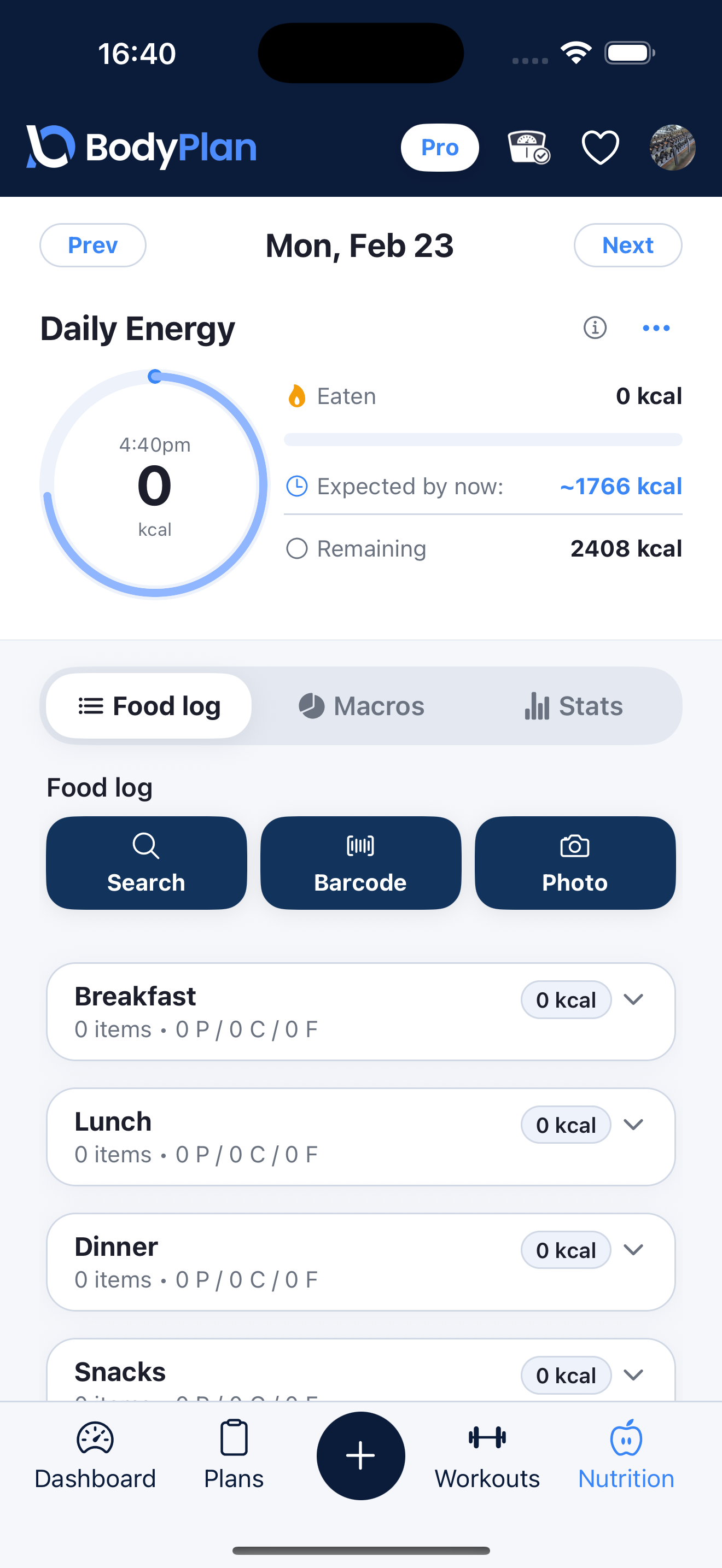
A number on a website only helps if you hit it. BodyPlan holds your calorie and macro targets alongside food logging, your training plan and your progress, so you can see how eating and training are working together.
- Calorie and macro targets tied to your goal
- Log meals by search, barcode or photo
- Targets update automatically as your plan changes


Free to download. No account needed to start.
How your calories are calculated
Your maintenance figure, often called TDEE or total daily energy expenditure, is the number of calories that keeps your weight roughly stable. This calculator estimates it with the Estimated Energy Requirement equation from the Dietary Reference Intakes, using your age, sex, height, weight and an activity level derived from how often you train.
It's the same calculation BodyPlan uses to set targets in the app, so the number here isn't a separate web estimate that might disagree with what you see once you install.
How your goal changes the target
Fat loss
A deficit of around 500 kcal a day below maintenance is a commonly used starting point, rising to about 750 at a higher BMI. The target is also held above a floor, because very low intakes make adequate nutrition hard and tend to cost you muscle alongside fat.
Muscle gain
A surplus of roughly 5-10% above maintenance supports muscle growth without adding fat faster than necessary. The smaller figure applies at a higher BMI, where there's less need to push.
Maintenance
Your target is your estimated maintenance. Useful if you're training for performance or holding your weight steady while you improve.
Where your macros come from
Every macro stays inside the Dietary Reference Intakes. Protein is set from your body weight, because your protein requirement tracks your body size, but kept within 10-35% of your calories. Fat sits at 20% of calories, the bottom of its range. Carbohydrate makes up the rest and never drops below the 130 g Recommended Dietary Allowance or 45% of calories, so on a large deficit protein gives way before carbs do.
If protein specifically is what you're after, the protein calculator shows your target with the range it sits inside.
Frequently asked questions
How is my maintenance calorie estimate calculated?
It uses the Estimated Energy Requirement equation from the Dietary Reference Intakes, based on your age, sex, height, weight and an activity level derived from how often you train. It's the same calculation BodyPlan uses to set your targets in the app.
How accurate is a TDEE calculator?
Predictive equations estimate the average requirement for people with your characteristics, and individual requirements vary meaningfully around that average. No equation using height, weight, age and sex can measure your expenditure directly. Treat the number as a starting point and adjust based on how your weight actually changes over two to three weeks.
Where do the protein, carb and fat numbers come from?
From the calorie target and your body weight, inside the Dietary Reference Intakes. Protein is set per kilogram of body weight for your goal but kept within 10-35% of calories, fat sits at 20% of calories, and carbohydrate makes up the remainder, never below the 130 g RDA or 45% of calories.
Why won't it give me a target if I'm under 19?
BodyPlan doesn't generate numerical calorie deficits, surpluses or macro targets for under-19s. Growth and development mean those decisions need individual assessment by an appropriately qualified clinician.
This calculator gives general nutrition estimates, not medical or dietetic advice. If you're pregnant, managing a medical condition, or have a history of disordered eating, speak to a qualified professional before changing your intake.